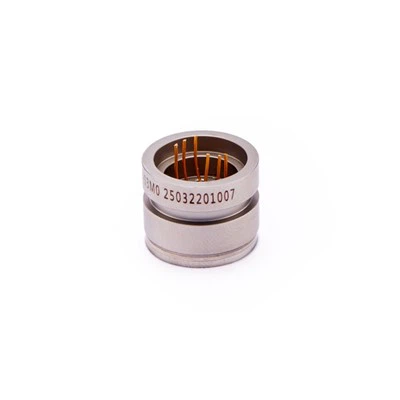
Aviation Fuel & Vapor Compatible
Wetted materials and internal construction are compatible with aviation gasoline, jet fuel, and fuel vapor-ensuring reliable long-term operation in fuel system environments.
0-15,000m Altitude Rating
Qualified for operation from ground level to 15,000 meters, covering the full flight envelope of commercial and military aircraft. Low-pressure performance verified at 9,400 Pa.
M12×1 Cone Seal Interface
M12×1-6h threaded port with 74° cone seal provides a robust, vibration-resistant connection that maintains leak integrity under extreme pressure and temperature cycling.
0.2-4.8V Linear Output
Proportional voltage output with built-in overvoltage protection (≤6.5V) and reverse protection (≥-0.7V), directly compatible with FADEC and engine monitoring inputs.
±0.5% FS Accuracy
Room-temperature accuracy of ±0.5% FS, maintained within ±1% FS across the full -55°C to +90°C operating range for consistent flight-line performance.
RTCA DO-160 & GJB Qualified
Subjected to rigorous environmental testing including temperature-altitude, vibration, shock, humidity, salt fog, sand/dust, and EMC per RTCA DO-160 and GJB standards.
Product Overview
•The aircraft fuel pressure transducer (also referred to as an aviation fuel pressure transmitter or aircraft fuel pressure sensor) is a flight-qualified instrument designed to measure the pressure of fuel and fuel vapor in aircraft fuel supply systems. It converts the applied pressure into a linear analog voltage output that is proportional to the measured value, enabling real-time fuel system health monitoring by engine control units, cockpit displays, and data acquisition systems.
•The transducer is engineered around a piezoresistive sensing element coupled with a dedicated signal conditioning circuit that provides a 0.2V to 4.8V output across a -50 kPa to 120 kPa gauge pressure range. The M12×1-6h threaded interface with 74° cone seal ensures a high-integrity, leak-free connection that withstands the vibration, pressure cycling, and thermal extremes encountered in airframe fuel lines. The compact 64mm × 26mm stainless steel housing is optimized for space-constrained installations in engine nacelles, fuel bays, and test rigs.
•Qualified to RTCA DO-160 airborne equipment standards and the equivalent GJB (Chinese military standard) environmental test requirements, this transducer has been validated for temperature-altitude, vibration, mechanical shock, humidity, salt fog, sand and dust, and electromagnetic compatibility. With a 15-year or 6,000-flight-hour design life, it delivers the reliability and durability demanded by aviation fuel system applications-from FADEC fuel pressure monitoring to flight test instrumentation and engine test benches.
Specifications
| Product Type | Aircraft fuel pressure transducer / aviation fuel pressure transmitter |
|---|---|
| Working Media | Aviation fuel, fuel vapor, air, water vapor |
| Pressure Range | -50 kPa ~ 120 kPa (gauge) |
| Pressure Type | Gauge (vented to ambient) |
| Overload Pressure | 2× working pressure |
| Accuracy (Room Temperature) | ≤ ±0.5% FS (at 25 ± 2°C) |
| Accuracy (Full Temperature Range) | ≤ ±1% FS |
| Output Signal | 0.2V ~ 4.8V (overvoltage ≤ 6.5V, reverse ≥ -0.7V) |
| Output Impedance | ≤ 100Ω |
| Supply Voltage | 10V ~ 36V DC |
| Operating Current | ≤ 30mA |
| Insulation Resistance | ≥ 250MΩ @ 200V DC |
| Operating Altitude | 0m ~ 15,000m |
| Ambient Operating Temperature | -55°C ~ +90°C |
| Media Temperature | -55°C ~ +100°C |
| Storage Temperature | -55°C ~ +80°C |
| Pressure Interface | M12×1-6h, 74° cone seal |
| Electrical Connector | Y4-4ZJBM receptacle (mating plug: Y4-4TK) |
| Housing Dimensions | 64mm × 26mm (approximate) |
| Weight | ≥ 0.25kg |
| Storage Life | ≥ 5 years |
| Total Life | ≥ 15 years or 6,000 flight hours |
| Environmental Qualification | RTCA DO-160 / GJB (temperature-altitude, vibration, shock, humidity, salt fog, sand & dust, EMC) |
Physical Structure

Transfer Function
The transducer output voltage (Y, in volts) is linearly proportional to the applied gauge pressure (X, in kPa) according to the following transfer function: Y = 0.02706 X + 1.5529
Where Y is the output voltage in volts, and X is the pressure in kPa. This linear relationship allows the host system to calculate fuel system pressure directly from the analog voltage reading without additional curve fitting or piecewise calibration.
🔌 Electrical Interface
| Pin | Signal | Description |
|---|---|---|
| 1 | VCC | Power Supply Positive (10-36V DC) |
| 2 | GND | Power Ground |
| 3 | Signal Output | Pressure Signal Output (0.2-4.8V) |
| 4 | Case | Housing / Shield |
Application
The aircraft fuel pressure transducer is engineered for the critical measurement points in aviation fuel supply and engine control systems. It provides the pressure data required by FADEC and engine monitoring units to maintain fuel system health, detect anomalies, and optimize engine performance. Its flight-qualified construction and aviation-specific media compatibility make it equally suited for flight test instrumentation, engine test benches, and fuel system calibration rigs where accurate, reliable pressure data is essential.
FADEC fuel pressure monitoring
Aircraft engine fuel system health
Flight test instrumentation
Cockpit fuel pressure display
Fuel boost pump performance testing
Aviation fuel vapor pressure measurement
FAQ
Q: What is an aircraft fuel pressure transducer and how does it differ from a general-purpose pressure sensor?
A: An aircraft fuel pressure transducer is a flight-qualified instrument specifically designed to measure fuel and fuel vapor pressure in aviation fuel systems. Unlike general-purpose sensors, it is qualified to RTCA DO-160 and GJB environmental standards, compatible with aviation fuels, rated for 0-15,000m altitude operation, and constructed with an M12×1 cone seal interface that maintains leak integrity under the vibration and thermal cycling of airframe installations.
Q: What media can this transducer measure?
A: The transducer is compatible with aviation fuel, fuel vapor, air, and water vapor. It is not intended for hydraulic fluid, oil, or corrosive chemicals. For other media, please consult our engineering team to discuss alternative wetted-material configurations.
Q: What is the M12×1 cone seal interface and why is it used in aviation?
A: The M12×1-6h threaded port with 74° cone seal creates a metal-to-metal sealing surface that is highly resistant to vibration loosening and thermal cycling. Cone seals are preferred in aviation fuel systems because they provide reliable, leak-free connections without elastomeric O-rings that can degrade when exposed to fuels and extreme temperatures.
Q: What accuracy can I expect across the operating temperature range?
A: Room-temperature accuracy is ±0.5% FS at 25 ± 2°C. Across the full -55°C to +90°C ambient operating range, accuracy is maintained within ±1% FS. This full-temperature specification is critical for aviation applications where fuel system pressure must be monitored reliably from ground cold-soak to high-altitude cruise.
Q: Can the pressure range or output signal be customized for my application?
A: Yes. While the standard configuration is -50 to 120 kPa gauge with 0.2-4.8V output, alternative pressure ranges, output signal spans, and connector types can be configured upon request. Our engineering team can work with your specific aircraft or test system requirements to deliver a tailored solution.
Hot Tags: aircraft fuel pressure transducer, China aircraft fuel pressure transducer manufacturers, suppliers, factory, aerospace pressure transducers, air pressure transducer sensor, best pressure transducer, ic pressure sensor, ic pressure transducer, no shock pressure transducer