



Product Introduction
-
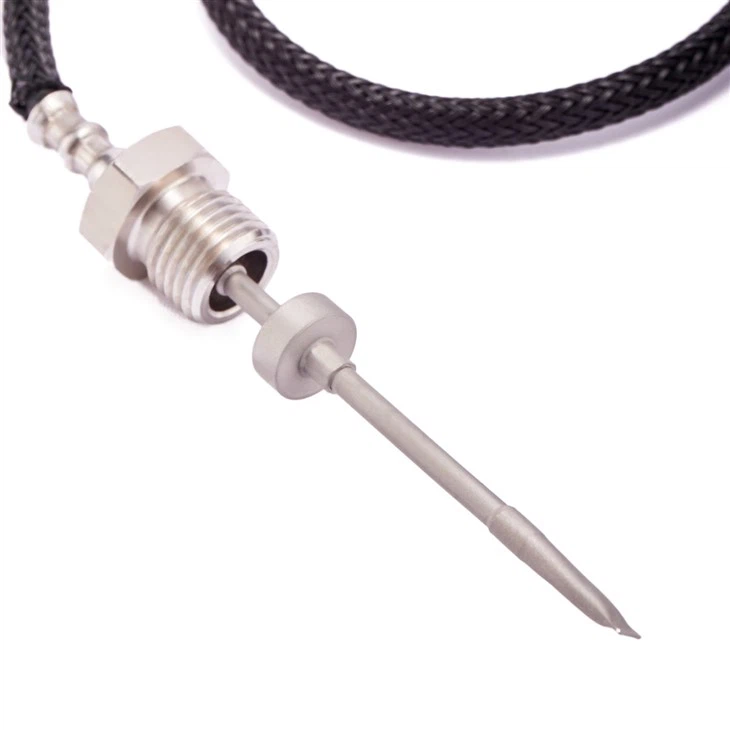
Exhaust Gas Temperature (EGT) Sensor a high-temperature thermocouple sensor specifically designed to measure high-temperature exhaust gases in the engine's exhaust system.
-
It delivers precise temperature data essential for protecting turbochargers and optimizing the regeneration cycles of emission control systems like DPF and SCR.
-
Constructed with a durable metal sheath and a step-type design, this robust sensor ensures reliable performance and easy installation in exhaust manifolds or catalytic converters. By providing accurate real-time data to the Engine Control Unit (ECU), the Exhaust Gas Temperature (EGT) Sensor plays a vital role in enabling efficient combustion and ensuring compliance with stringent global emission regulations.
Features
Extreme Temperature Resilience
With its high-temperature resistant sheath and anti-rotation structure, the sensor withstands continuous temperatures up to +1000°C and rapid thermal gradients, and adapt to high-frequency thermal shocks in exhaust systems.
Critical Emission Management
It delivers the precise data required for effective DPF regeneration and SCR system control, which is essential for compliance with stringent global emission standards.
Specifications
|
Temperature Range |
-40°C~1000°C |
|
Nominal Resistance |
200Ω@0°C |
|
Insulation Resistance |
≥10MΩ@500VDC at 25°C |
|
Stability |
≤0.04%@1000h |
|
Vibration |
4g, 10Hz~5000Hz |
Application
The Exhaust Gas Temperature (EGT) Sensor is ability to provide accurate and reliable temperature data under extreme conditions makes it essential for the following applications.
Automotive Powertrain Systems
·Protecting turbochargers from overheating in passenger cars, trucks, and buses.
·Managing regeneration cycles for Diesel Particulate Filters (DPF) and Selective Catalytic Reduction (SCR) systems.
·Optimizing combustion and fuel efficiency by providing real-time exhaust temperature feedback to the Engine Control Unit (ECU).
Industrial Engines & Power Generation
For stationary and mobile industrial engines, EGT sensors help enhance operational safety and performance.
·Monitoring exhaust temperatures in diesel generators and gas turbines to prevent engine damage.
·Providing critical data for predictive maintenance of industrial power systems.
Off-road and special vehicles
·Construction and agricultural machinery such as excavators and tractors.
·Autonomous robots and industrial drones requiring thermal oversight.
·Mining and forestry equipment operating under high-load conditions.
Energy & Environmental Protection Equipment
·Waste incineration plants and industrial boilers for flue gas temperature monitoring.
·Monitoring systems for industrial kilns and furnaces.
·Supporting environmental compliance by enabling accurate emissions data collection.
Kind Tips
To ensure optimal performance and longevity of your Exhaust Gas Temperature (EGT) Sensor, please follow these essential guidelines during selection, installation, and operation.
1. Correct Selection for Optimal Match
Select the appropriate model based on the actual exhaust temperature peak (e.g. diesel engine is usually 800°C, gasoline engine may be higher), accuracy requirements (e.g. ±7°C@1000°C) and communication protocol (e.g. SENT). Thermocouple type (e.g. K type) is a common choice.
2. Proper Installation is Critical
The installation location should represent average exhaust temperature, typically after the turbine or before the DPF. Insert the probe deep enough to center the exhaust airflow, avoiding heat dissipation from the pipe wall. The stepped design facilitates secure mounting and ensures a leak-proof seal.
3. Ensure Reliable Electrical Connections
Always use shielded cables and proper grounding to protect the signal from electromagnetic interference, especially from ignition systems. For thermocouple-based sensors, ensure matched compensating cables or a correct digital interface are used to maintain signal accuracy.
4. Mind the Environment and Maintenance
The sensor operates in a harsh environment. Choose a mechanically robust design to withstand vibration and thermal shock. Periodically inspect for carbon buildup that can slow response time, and utilize the built-in diagnostics to monitor for fault codes, facilitating proactive maintenance.
FAQ
Q: Are your sensors compatible with modern vehicle communication protocols?
A: Yes, we offer sensors that support SENT (Single Edge Nibble Transmission) rev.3 & rev.4 digital protocols, ensuring seamless integration with modern engine control units (ECUs).
Q: Can you provide custom-designed EGT sensors for specific applications?
A: Absolutely. We offer customization options including probe length, sheath diameter, connector types, and calibration to meet your specific needs.
Q: How durable are your sensors in high-vibration environments?
A: Our sensors feature a robust anti-rotation structure and high-temperature alloy sheath, specifically engineered to withstand extreme vibration, thermal shock, and harsh exhaust conditions.
Q: Are you a manufacturer or a distributor?
A: We are a professional manufacturer of sensors with our own factory, which enables us to control quality and provide competitive prices and flexible customization services.
Q: What is your warranty policy?
A: The product has a one-year warranty. During this period, we will repair or replace any product quality issues and provide ongoing strong technical support.
Hot Tags: exhaust gas temperature (egt) sensor, China exhaust gas temperature (egt) sensor manufacturers, suppliers, factory, waterproof thermometer, Adjustable Thread Mount Temperature Sensor, thermistor temperature sensor, Automotive Coolant Temperature Sensor, thermal probe sensor, smart thermometer


