

(I) Core Working Principle
A depth sensor belongs to the category of pressure‑based depth sensors. Its core principle relies on the hydrostatic pressure law to measure water depth. Essentially, it is a pressure sensing unit combined with a pressure‑to‑depth conversion algorithm.
The greater the water depth, the higher the static pressure formed by the weight of the water above. The sensor accurately measures the liquid pressure and converts it back to the actual depth. The hydrostatic pressure formula is: P = ρgh
Rearranging the formula gives the depth calculation: h = P / (ρg)
Where:
h = measured water depth
P = relative liquid pressure (after deducting atmospheric pressure)
ρ = liquid density (approx. 1000 kg/m³ for fresh water, approx. 1025 kg/m³ for sea water)
g = gravitational acceleration (standard value 9.8 m/s²)
For quick reference: in typical fresh water, every 1‑meter increase in depth corresponds to an approximate pressure increase of 10 kPa. Pressure and depth have a linear relationship.
(II) PG440 Depth Sensor – Product Overview
The PG440 depth sensor is developed based on our in‑house designed silicon piezoresistive pressure chip, with special optimization for seawater measurement. It uses an isolated pressure‑sensing element to contact the measured medium. The entire unit is controlled by a microcontroller and features a CAN 2.0 bus for digital signal transmission.
The product consists of three major parts: mechanical structure, hardware circuits, and embedded software. The mechanical structure includes the sensing element, pressure port, housing, end cap, waterproof connector, and connecting cable. The hardware comprises four functional circuit boards. The embedded software is programmed into the signal processing board, handling data calculation and command interaction.
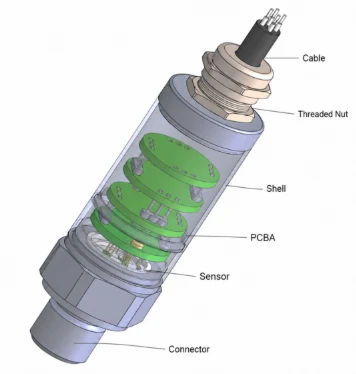

1. Operating Process
The sensor is installed via a G1/4 external thread. The measured liquid enters through the pressure port and acts on the built‑in piezoresistive sensing chip, completing pressure signal acquisition. In the hardware circuit, the microcontroller communicates with the signal conditioning chip via the SPI interface, providing the reference voltage and operating current for the sensing element, while simultaneously reading ADC sampling data from the conditioning chip. After algorithmic compensation and calculation, the data is converted into a standard pressure value and output via the CAN 2.0 bus.
2. Mechanical Assembly Process
The internal absolute pressure chip is bonded to the pressure‑sensitive element base with silicone rubber.
The pressure‑sensitive element base and the corrugated diaphragm are laser‑welded sealed and filled with oil.
The complete pressure‑sensitive assembly is laser‑welded to the pressure port.
The pressure port to the housing, and the housing to the end cap, are both sealed by laser welding.
The waterproof connector is fastened to the end cap via threaded connection, ensuring overall waterproof performance.
3. Circuit Board Functions
The unit includes four functional circuit boards:
Signal adapter board – Soldered to the back pins of the sensing probe for signal routing and transition.
Signal processing board – Performs calculation, fitting, and conversion of the raw sampled signals, simultaneously outputting analog voltage and digital signals.
Power supply board – Provides stable power to all circuit modules.
EMC board – Suppresses electromagnetic interference, enhancing operational stability in complex environments.
Pressure Calibration Scheme
To eliminate temperature drift and errors introduced by hardware circuits, the product is accompanied by a dedicated PC‑based calibration system, working in conjunction with a temperature chamber and pressure calibration equipment for complete calibration. The system simultaneously collects pressure, temperature, and ADC data, performs calculations, signal amplification, and parameter correction through the microcontroller and conditioning chip, ultimately achieving high‑precision digital signal output.
Calibration procedure: Six typical temperature points are selected: -10°C, 5°C, 20°C, 40°C, 55°C, and 80°C. At each temperature, five standard pressure levels are applied: 0 MPa, 1.75 MPa, 3.5 MPa, 5.25 MPa, and 7 MPa. The device simultaneously captures the corresponding ADC values under these conditions. Compensation parameters are generated through algorithmic fitting and stored in the microcontroller's Flash memory, achieving full‑temperature‑range and full‑scale error compensation.
Electrical and Protection Parameters
Power supply: Input voltage range of the power chip is 9 V to 40 V, supporting 28 V conventional supply. After onboard regulation, the operating voltage is 5 V.
Electrical insulation: Insulation resistance ≥100 MΩ at 100 V DC; the circuit is electrically isolated from the metal housing.
Power consumption: Rated operating power <0.6 W; measured power consumption of a mature model in the same series is only 0.3 W, demonstrating excellent low‑power performance.
Protection rating: Designed to IP65 (per GB/T 4208‑2017); actual testing of similar models has reached IP67, ensuring reliable water and dust protection.
Core Performance and Weight Specifications
Measurement accuracy: Combined accuracy ≤0.1% FS (full scale). The product uses an absolute pressure sensing chip with mature temperature and pressure compensation algorithms, delivering stable accuracy.
Total weight: Component weight breakdown – pressure port 50 g, sensing element 18 g, housing 20 g, end cap 15 g, waterproof connector 15 g, cable 15 g, circuit boards 21 g, potting layer 20 g. Total unit weight is 174 g, reflecting a lightweight structural design.
Main Program Flow

The PG440 offers high accuracy, low power consumption, and robust construction – ideal for fresh water, sea water, and other liquid depth monitoring. Contact us today for more information or a customized solution.
📧 Email: mihuitec@gmail.com
📞 Phone: +86 18066965135
🌐 Website: www.mihuitec.com


