

I. Overview of Explosion Protection Certification
The quality of explosion‑proof products directly affects industrial production safety. Most countries and regions around the world have incorporated explosion‑proof product certification into mandatory control categories. The current mainstream explosion protection certification systems fall into four major categories: the IECEx certification (International Electrotechnical Commission), the European Union ATEX certification, the Russian 012 explosion‑proof certification, and the Chinese explosion protection certification system.
The explosion protection certificate for a pressure sensor is an official document issued by a nationally accredited authority, confirming that the sensor has been tested and will not create an ignition source nor ignite flammable or explosive environmental media, and can therefore be safely used in hazardous locations.
II. Common Explosion Protection Types for Pressure Sensors
1. Intrinsically Safe Type Ex i (ia / ib)
This is the most commonly used type of intrinsic safety. Through voltage‑limiting and current‑limiting circuit designs, the internal electrical energy is kept at an extremely low level. Even if the device short‑circuits or malfunctions, it cannot generate sparks, and its surface temperature rise remains below the critical value for ignition.
Advantages: Supports live maintenance, compact size, high cost‑effectiveness
Common marking examples: Ex ia IIC T6 Ga, Ex ib IIC T4 Gb
2. Flameproof Type Ex d
This type uses a high‑strength, thickened metal enclosure. Even if an internal explosion occurs, the enclosure will not rupture, containing the internal flame and pressure wave and preventing ignition of external flammable gases.
Common marking example: Ex d IIC T6 Gb
III. Product Introduction
The PA600 series pressure sensor strictly complies with national standards GB/T 3836.1‑2021 Explosive atmospheres – Part 1: General requirements for equipment and GB/T 3836.4‑2021 Explosive atmospheres – Part 4: Equipment protection by intrinsic safety "i". It has been reviewed and tested by a nationally designated explosion protection inspection body and has officially received the explosion protection certificate.
This product uses a diffusion silicon pressure sensing element as its core measuring component. After amplification by a dedicated signal conditioning circuit, the on‑site pressure signal is converted into various standard electrical signals. The pressure value has a precise linear relationship with the output electrical signal, achieving high‑accuracy pressure measurement in industrial environments.
The unit is housed in an all‑stainless‑steel encapsulated structure, offering stable performance and strong environmental protection. It is widely used in process pressure measurement and automatic control applications in industries such as oil & gas, chemical, metallurgy, electric power, and hydrogeology.
IV. Key Product Parameters
| Model | Supply Voltage | Pressure Range | Protection Rating | Explosion Protection Marking |
|---|---|---|---|---|
| PA600 | DC5V | 0~40MPa | IP65 | Ex ib IIC T4 Gb |
V. Electrical Terminal Definition
| Pin No. | Definition |
|---|---|
| 1 | V+ (Power supply positive) |
| 2 | GND (Ground) |
| 3 | 0+ (Signal output positive) |
VI. Intrinsically Safe System Wiring and Parameter Matching
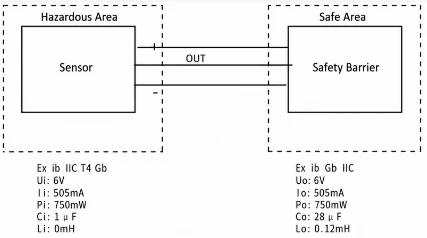
1. System Architecture
Hazardous area: Explosion‑proof pressure sensor (Ex ib IIC T4 Gb)
Safe area: Intrinsic safety barrier
The two components together form an intrinsically safe pressure measurement system.
2. Key Intrinsically Safe Parameters
Pressure sensor parameters: Ui = 6 V DC, Ii = 505 mA, Pi = 750 mW, Ci = 1 μF, Li = 0 mH
Intrinsic safety barrier parameters: Um = 250 V AC/DC, Uo = 6 V DC, Io = 505 mA, Po = 750 mW
3. Matching Rules for Intrinsically Safe Parameters
When selecting the cable between the barrier and the sensor, the following matching rules must be observed: Uo ≤ Ui, Io ≤ Ii, Po ≤ Pi, Cc ≤ Co – Ci, Lc ≤ Lo – Li
Parameter definitions:
Cc , Lc : Maximum distributed capacitance and distributed inductance permitted for the cable between the barrier and the sensor
Co , Lo : Maximum external capacitance and maximum external inductance allowed by the barrier
Uo , Io , Po : Maximum output voltage, maximum output current, and maximum output power of the barrier
Ui , Ii , Pi : Maximum allowable input voltage, input current, and input power of the sensor
Ci , Li : Internal inherent capacitance and inherent inductance of the sensor
VII. Product Structural Features
The housing of this series of pressure sensors is manufactured using stainless steel die‑casting technology, meeting the impact strength and mechanical strength requirements specified in national standards and product technical specifications. Internal creepage distances and clearances comply with explosion protection standard requirements, ensuring reliable insulation performance and electrical safety.
VIII. Installation and Use Specifications
Altitude not exceeding 2000 m; ambient atmospheric pressure: 80 to 110 kPa
Ambient operating temperature: 0°C to +80°C
Ambient relative humidity: ≤95% (at 25°C)
Suitable for explosive gas atmospheres: Class IIA to IIC, Groups T1 to T4 combustible gas locations
Installation site free from significant mechanical oscillation, shock, or strong vibration
No corrosive gases harmful to insulating materials in the surrounding area
No risk of dripping water or liquid immersion at the installation position
On‑site pollution degree: Level 3
IX. Storage and Transportation Requirements
The product must be stored in a well‑ventilated, dry, clean warehouse, avoiding damp or corrosive environments.
During transportation, adequate protection must be provided against rain, severe vibration, and impact.
Need an explosion‑proof pressure sensor for your hazardous location?
The PA600 series offers reliable intrinsic safety (Ex ib) and flameproof (Ex d) options, certified to international and national standards. Contact us today for expert advice and a tailored solution for your application.
📧 Email: mihuitec@gmail.com
📞 Phone: +86 18066965135
🌐 Website: www.mihuitec.com


